No. 445,792 – Plane (Granville W. Wright) (1891)

[paiddownloads id=”471″]445792


UNITED STATES PATENT OFFICE.

_________________

GRANVILLE W. WRIGHT, OF NEW HAVEN, CONNECTICUT,
ASSIGNOR TO SARGENT & COMPANY, OF SAME PLACE.

PLANE.

_________________

SPECIFICATION forming part of Letters Patent No. 445,792, dated February 3, 1891.
Application filed October 6, 1890. Serial No. 367,225. (No model.)

_________________

To all whom it may concern:

Be it known that I, GRANVILLE W. WRIGHT, of New Haven, in the county of New Haven and State of Connecticut, have invented new Improvements in Planes; and I do hereby declare the following, when taken in connection with accompanying drawings and the letters of reference marked thereon, to be a full, clear, and exact description ot the same, and which said drawings constitute part of this specincation, and represent, in —

Figure 1, a side view with a portion of the plane-iron broken away to illustrate its connection with the adjusting-lever; Fig. 2, a top view with the plane-iron removed; Fig. 3, a face view of the plane-iron seat with the lever removed to show the transverse slot J and the slide therein.

This invention relates to an improvement in that class of planes in which the stock is made from metal, and in which provision is made for adjusting the upper end of the iron laterally, so as to change the angle of the iron with relation to the working-face of the stock, the invention relating particularly to the mechanism for producing such lateral adjustment; and it consists in the construction as hereinafter described, and particularly recited in the claim.

A represents the stock, which is made from cast-iron, and in which an inclined seat B is formed as a bed for the iron C, D representing the throat of the stock.

E represents the clamp by which the iron is held to its seat, all substantially as in the usual construction, and as here represented it is provided with an adjusting-screw F, by means of which the plane-iron may be raised or lowered to make the out less or more, as the case may be, also in the usual manner.

The particular mechanism as thus far described is too well known to require description.

The upper end of the seat B is recessed, and in the recess a lever G is hung upon a pivot H, and so as to swing in the plane of the seat B, on which the iron rests, this lever G lying directly back of the iron when in place, as seen in Fig. 1. Through the hub or body of this lever a segment-shaped slot I is formed eccentric to the pivot H, and as seen in Fig. Transversely across that portion of the bed in which the lever is hung is a slot J, (see Fig. 3,) in which a slide K is arranged, the said slide presenting a head L on the face adapted to stand in the vertical slot of the plane-iron, the width of the head being substantially the same as the width of the slot.

The said slide extends through the slot I of the lever G, and so that by turning the said lever G to the right or left the slide K will be moved transversely, according to the eccentricity of the slot I, and as indicated in broken lines, Fig. 2, and because the head L of the slide K stands in the slot of the plane-iron it necessarily follows that the upper end of the plane-iron is moved accordingly to the right or left, and such movement of the upper end of the plane-iron correspondingly turns the said iron to change its relation to the face of the plane, and so that the plane-iron may be adjusted to bring the line of its edge parallel with the face of the plane, or inclined thereto, as may be desired. The lever G preferably extends slightly above the upper edge of the plane-iron, so as to form a handle or thumb-piece, as M, by which it may be readily adjusted. When the plane-iron is secured to its seat and it is found necessary to change the line of the cutting-edge of the plane-iron with relation to the face of the plane, it is only necessary to turn the lever G to the right or left, as the adjustment may require, the clamp which secures the plane-iron to its seat being sufficient to hold it in place and yet permit such adjustment to be made, so that the adjustment may be made after the plane-iron has been firmly secured and without change of such securing devices.

From the foregoing it will be understood that I do not claim, broadly, a lever arranged in the stock back of the plane-iron as a means for adjusting the plane-iron transversely; but

What I do claim as my invention is —

In a plane substantially such as described, and in which the plane-iron is secured upon the seat in the stock, the stock constructed with a transverse slot above said seat and in rear of the plane-iron, a lever hung upon the stock in rear of the plane-iron and so as to swing in a plane parallel with the plane-iron and across said transverse slot, the lever constructed with a slot eccentric to the pivot on which it swings, and a, slide working in said transverse slot and extending through the said segmental slot of the lever into engagement with the plane-iron, substantially as and for the purpose described.

In testimony whereof I have signed this specification in the presence of two subscribing witnesses.

GRANVILLE W. WRIGHT.

Witnesses:
E. H. EGGLESTON,
W. S. COOKE.
No. 444,897 – Carpenter’s Plane (Oliver Longval) (1891)

[paiddownloads id=”470″]444897


UNITED STATES PATENT OFFICE.

_________________

OLIVER LONGVAL, OF MILLBURY, MASSACHUSETTS.

CARPENTER’S PLANE.

_________________

SPECIFICATION forming part of Letters Patent No. 444,897, dated January 20, 1891.
Application filed April 5, 1889. Serial No. 306,093. (No model.)

_________________

To all whom it may concern:

Be it known that I, OLIVER LONGVAL, of Millbury, in the county of Worcester and State of Massachusetts, have invented certain new and useful Improvements in Carpenters’ Planes; and I do hereby declare that the following is a full, clear, and exact description thereof, reference being had to the accompanying drawings, forming a part of this specification, and in which —

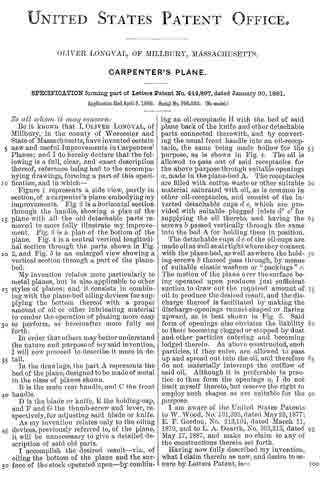
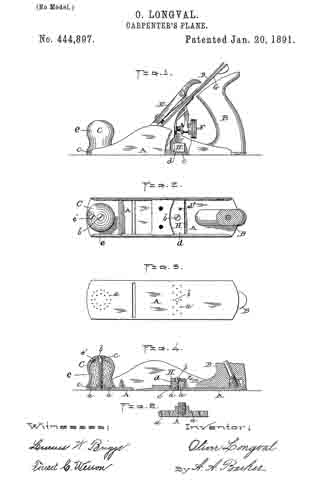
Figure 1 represents a side view, partly in section, of a carpenters plane embodying my improvements. Fig. 2 is a horizontal section through the handle, showing a plan of the plane with all the old detachable parts removed to more fully illustrate my improvement. Fig. 3 is a plan of the bottom of the plane. Fig. 4 is a central vertical longitudinal section through the parts shown in Fig. 2, and Fig. 5 is an enlarged view showing a vertical section through a part of the plane-bed.

My invention relates more particularly to metal planes, but is also applicable to other styles of planes; and it consists in combining with the plane-bed oiling devices for supplying the bottom thereof with a proper amount of oil or other lubricating material to render the operation of planing more easy to perform, as hereinafter more fully set forth.

In order that others may better understand the nature and purpose of my said invention, I will now proceed to describe it more in detail.

In the drawings, the part A represents the bed of the plane, designed to be made of metal in the class of planes shown.

B is the main rear handle, and C the front-handle.

D is the blade or knife, E the holding-cap, and F and G the thumb-screw and lever, respectively, for adjusting said blade or knife.

As my invention relates only to the oiling devices, previously referred to, of the plane, it will be unnecessary to give a detailed description of said old parts.

I accomplish the desired result — viz., of oiling the bottom of the plane and the surface of the stock operated upon — by combining an oil-receptacle H with the bed of said plane back of the knife and other detachable parts connected therewith, and by converting the usual front handle into an oil-receptacle, the same being made hollow for the purpose, as is shown in Fig. 4. The oil is allowed to pass out of said receptacles for the above purpose through suitable openings a, made in the plane-bed A. The receptacles are filled with cotton waste or other suitable material saturated with oil, as is common in other oil-receptacles, and consist of the inverted detachable cups d e, which are provided with suitable plugged inlets d’ e’ for supplying the oil thereto, and having the screws b passed vertically through the same into the bed A for holding them in position.

The detachable cups d e of the oil-cups are made oil as well as air tight where they connect with the plane-bed, as well as where the holding-screws b thereof pass through, by means of suitable elastic washers or “packings” c. The motion of the plane over the surface being operated upon produces just sufficient suction to draw out the required amount of oil to produce the desired result, and the discharge thereof is facilitated by making the discharge-openings tunnel-shaped or flaring upward, as is best shown in Fig. 5. Said form of openings also obviates the liability to their becoming clogged or stopped by dust and other particles entering and becoming lodged therein. As above constructed, such particles, if they enter, are allowed to pass up and spread out into the oil, and therefore do not materially interrupt the outflow of said oil. Although it is preferable in practice to thus form the openings a, I do not limit myself thereto, but reserve the right to employ such shapes as are suitable for the purpose.

I am aware of the United States Patents to W. Wood, No. 191,393, dated May 29, 1877; E. F. Gordon, No. 213,104, dated March 11, 1879, and to L. A. Dearth, No. 363,213, dated May 17, 1887, and make no claim to any of the constructions therein set forth.

Having now fully described my invention, what I claim therein as new, and desire to secure by Letters Patent, is —

In a carpenter’s plane, the combination, with the plane-bed A, having a series of vertical openings a, therein, of detachable cups d and e, having suitable plugged inlets d’ e’ and fitted over said openings a, in the bed, the fastening-screws b, passed vertically through the oil-receptacles into the bed, the absorbent material contained within the oil-receptacles, and the packings c, interposed between the under side of the heads of the fastening-screws and the oil-receptacles and between said oil-receptacles and the top of the bed, substantially as and for the purpose set forth.

OLIVER LONGVAL.

Witnesses:
A. A. BARKER,
W. B NOURSE.

No. 441,758 – Device For Setting The Edges Of Plane-Bits (Edrick Gowdy) (1890)

[paiddownloads id=”469″]441758


UNITED STATES PATENT OFFICE.

_________________

EDRICK GOWDY, OF ANSONIA, CONNECTICUT.

DEVICE FOR SETTING THE EDGES OF PLANE-BITS.

_________________

SPECIFICATION forming part of Letters Patent No. 441,758, dated December 2, 1890.
Application filed April 10, 1890. Serial No. 347,366. (No model.)

_________________

To all whom it may concern:

Be it known that I, EDRICK GOWDY, a citizen of the United States, residing at Ansonia, in the county of New Haven and State of Connecticut, have invented certain new and useful Improvements in Devices for Setting the Edges of Plane-Bits and other Tools; and I do hereby declare the following to be a f ull, clear, and exact description of the invention, such as will enable others skilled in the art to which it appertains to make and use the same.

My invention has for its object the production of a simple and inexpensive device which may be readily carried about in a tool-box, and which will act to turn forward slightly the edges of plane-bits and other tools. I have found in practice in planing all classes of wood, it being particularly true in the case of knotty close-grained woods, that by turning forward the edge of the bit of the plane I can secure very much better results in the way of a line smooth finish, avoid all danger of chipping out, and can retain the plane-bit sharp and in good condition for use much longer than when the edge is left to project downward in a line with the front of the blade in the usual manner; and in order that I may set the edges of plane-bits without inconvenience and at any time I have devised the simple and novel tool of which the following description, in connection with the accompanying drawings, is a specification, numbers being used to denote the several parts.

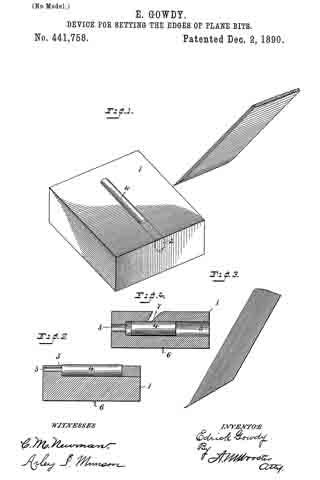
Figure 1 is a perspective of my novel tool, showing also a portion of a plane-bit at the angle at which it is passed over the turning-piece; Fig. 2, a longitudinal section of my novel tool, showing the turning-piece in elevation. Fig. 3 is an elevation on a greatly-enlarged scale of the lower end of a plane-bit, showing the edge turned forward as after it has been acted upon by my novel tool; and Fig. 4 is a section similar to Fig. 2, showing a slightly-different mode in which I have carried my invention into effect.

1 denotes a block, preferably made of wood, which is provided with a hole 3, bored into the block from either end near the top of the block and adapted to receive a round piece of metal 4, which I term a “turning-piece.” This turning-piece is preferably made of chilled steel, and is made slightly larger than the hole, so as to require to be driven therein and remain firmly wherever it is placed. It will be noticed that hole 3 is made near enough to the top of the block so that the upper portion of the hole is open. This permits the rounded surface of the turning-piece after it is driven in to project slightly above the surface of the block, as is clearly shown in the drawings. In practice I preferably drive a plug 2 into the hole after the turning-piece has been driven in and smooth it off level with the top and end of the block, so as to give a neat finish to the tool. For convenience in driving the turning-piece out, should it be required, I preferably provide a hole 5, which extends into hole 3 from the other end of the block. Should the turning-piece become worn or nicked in use, it may readily be driven out, given a partial rotation to place another portion of the rounded surface in operative position, and then driven back to place and the plug driven in after it.

In use, after sharpening a plane-bit or other blade, the operator takes the blade firmly in his hand, holding it at about the angle indicated in the drawings, and passes it backward and forward over the turning-piece one or more times, as may be required. The action of the portion of the turning-piece lying above the surface of the block will be to turn the cutting-edge forward slightly, as shown in Fig. 3. In Fig. 4 I have shown the block as provided with a transverse undercut groove 7, the undercut side of said groove being the forward side, which is made perfectly straight, but is inclined downward and inward. The hole to receive the turning-piece is lower down in the block and is intersected by the groove, the rounded surface of the turning-piece lying about the same distance above the bottom of the groove that it does above the surface of the block in the other form. In using this form the operator passes the blade, the edge of which is to be turned through the groove and over the surface of the turning-piece one or more times in the same manner as in using the other form.

In order to hold the block firmly in place and make the tool convenient in use, I provide two or more sharpened prongs 6, which project downward from the bottom of the block to engage a work-bench or plank and hold the block firmly in place when it is desired to use the tool.

Having thus described my invention, I claim —

1. A tool for setting cutting-edges, consisting of a, block having a, rounded turning-piece driven therein, the upper portion of which extends slightly above the surface of the block, so that a, cutting-edge passed over the surface of the block will engage the rounded surface of the turning-piece and be turned slightly forward, as and for the purpose set forth.

2. A tool for setting cutting-edges, consisting of a block having a rounded turning-piece driven therein and extending slightly above the surface thereof, and prongs upon the under side thereof, whereby the block may be held in place in use.

In testimony whereof I afflx my signature in presence of two witnesses.

EDRICK GOWDY.

Witnesses:
CHAS. S. WEEKS,
Mrs. E. GOWDY.

No. 440,558 – Plane (August Frömming) (1890)

[paiddownloads id=”468″]440558


UNITED STATES PATENT OFFICE.

_________________

AUGUST FRÖMMING, OF LANHAM, KANSAS.

PLANE.

_________________

SPECIFICATION forming part of Letters Patent No. 440,558, dated November 11, 1890.
Application filed April 30, 1890. Serial No. 350,073. (No model.)

_________________

To all whom it may concern:

Be it known that I, AUGUST FRÖMMING, a citizen of the United States, residing at Lanham, in the county of Washington and State of Kansas, have invented certain new and useful Improvements in Planes; and I do hereby declare the following to be a full, clear, and exact description of the invention, such as will enable others skilled in the art to which it appertains to make and use the same.

My invention consists in a new and improved plane, which will be hereinafter fully described and claimed.

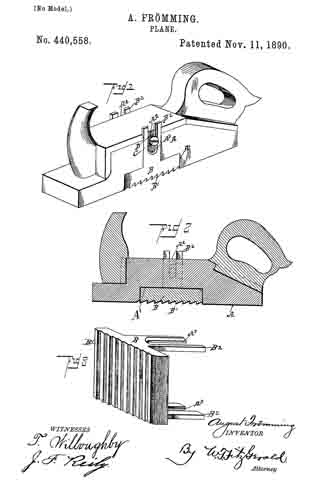
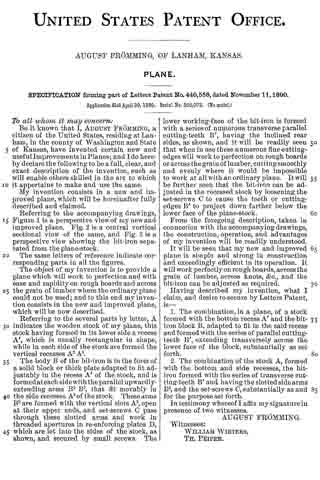
Referring to the accompanying drawings, Figure 1 is a perspective view of my new and improved plane. Fig. 2 is a central vertical sectional view of the same, and Fig. 3 is a perspective view showing the bit-iron separated from the plane-stock.

The same letters of reference indicate corresponding parts in all the figures.

The object of my invention is to provide a plane which will work to perfection and with ease and rapidity on rough boards and across the grain of lumber where the ordinary plane could not be used; and to this end my invention consists in the new and improved plane, which will be now described.

Referring to the several parts by letter, A indicates the wooden stock of my plane, this stock having formed in its lower side a recess A’, which is usually rectangular in shape, while in each side of the stock are formed the vertical recesses A2 A2.

The body B of the bit-iron is in the form of a solid block or thick plate adapted to fit adjustably in the recess A’ of the stock, and is formed at each side with the parallel upwardly-extending arms B2 B2, that fit movably in the side recesses A2 of the stock. These arms B2 are formed with the vertical slots A3, open at their upper ends, and set-screws C pass through these slotted arms and work in threaded apertures in re-enforcing plates D, which are let into the sides of the stock, as shown, and secured by small screws. The lower working-face of the bit-iron is formed with a series of numerous transverse parallel cutting-teeth B’, having the inclined rear sides, as shown, and it will be readily seen that when in use these numerous fine cutting-edges will work to perfection on rough boards or across the grain of lumber, cutting smoothly and evenly where it would be impossible to work at all with an ordinary plane. It will be further seen that the bit-iron can be adjusted in the recessed stock by loosening the set-screws C to cause the teeth or cutting-edges B’ to project down farther below the lower face of the plane-stock.

From the foregoing description, taken in connection with the accompanying drawings, the construction, operation, and advantages of my invention will be readily understood.

It will be seen that my new and improved plane is simple and strong in construction and exceedingly efficient in its operation. It will work perfectly on rough boards, across the grain of lumber, across knots, &c., and the bit-iron can be adjusted as required.

Having described my invention, what I claim, and desire to secure by Letters Patent, is —

1. The combination, in a plane, of a stock formed with the bottom recess A’ and the bit-iron block B, adapted to fit in the said recess and formed with the series of parallel cutting-teeth B’, extending transversely across the lower face of the block, substantially as set forth.

2. The combination of the stock A, formed with the bottom and side recesses, the bit-iron formed with the series of transverse cutting-teeth B’ and having the slotted side arms B2, and the set-screws C, substantially as and for the purpose set forth.

In testimony whereof I affix my signature in presence of two witnesses.

AUGUST FRÖMMING.

Witnesses:
WILLIAM WIETERS,
TH. PEIPER.