No. 864,101 – Plane (Edward S. Marks) (1907)
[paiddownloads id=”644″]864101


UNITED STATES PATENT OFFICE.

_________________

EDWARD S. MARKS, OF AUBURN, NEW YORK, ASSIGNOR TO OHIO TOOL COMPANY, OF AUBURN, NEW YORK, A CORPORATION OF NEW YORK.

PLANE.

_________________

864,101. Specification of Letters Patent. Patented Aug. 20, 1907.
Application filed March 7, 1907. Serial No. 361,030.

_________________

To all whom it may concern:

Be it known that I, EDWARD S. MARKS, a citizen of the United States, residing at Auburn, in the county of Cayuga and State of New York, have invented or discovered certain new and useful Improvements in Planes, of which the following is a specification, reference being had therein to the accompanying drawings.

This invention relates generally to bench planes and more particularly to the manner of seating the “frog”, or support for the bit or cutting iron, upon the sole or bottom of the plane. In planes of this character the frog is ordinarily made in a piece separate from the body or stock of the plane and bolted or otherwise secured thereto, and is adjustable longitudinally of the plane body in order to permit the effective size of the throat or opening in the sole of the plane to be varied. When, however, a frog of this character is adjusted to a position in which its forward or bit-supporting face lies in a plane in advance of the rear edge of the throat or opening in the sole, the lower end of the bit is left unsupported for a distance above its cutting edge equal to the thickness of the sole. In order to remedy this defect and to provide a support for the bit as near the cutting edge thereof as possible it has been proposed to provide a thinned down portion of the sole at the rear of the mouth or throat by cutting away the sole at its upper side at this point, and to provide the frog with a depending lip at its forward side which is received in the recess formed by cutting away the sole as above described, and which is adapted to support the bit at a point close to its cutting edge. It is necessary, however, in order to prevent rattling of the parts and to provide a firm support for the bit against the thrust of the plane, that the frog have a firm bearing upon the sole of the plane at a plurality of points and that it be firmly and tightly bolted or otherwise secured thereto. In the construction last referred to one of the supports of the frog upon the sole is provided by causing the depending lip on the frog to bear upon the thinned down portion of the sole at the rear of the throat. This is undesirable, since when the bolts which secure the frog to the sole are screwed down tightly the bearing of the lip of the frog upon the thinned down and therefore weakened portion of the sole tends to spring said thinned down portion out of the plane of the lower surface of the sole, thereby seriously impairing the efficiency of the plane.

One object, therefore, of my invention is to provide means for supporting a frog of the character above referred to in such a manner that the bit is supported at a point close to the cutting edge thereof while no tendency to warp any portion of the sole out of its proper plane is produced.

A further object of my invention is to dispense with the heavy raised frog seats which have been heretofore used in planes of this character, thereby simplifying the manufacture of these planes and reducing their weight.

A still further object of my invention is to improve certain details of construction in planes of this character, as will hereinafter appear.

To these ends my invention consists in certain constructions and combinations of parts hereinafter described and particularly pointed out in the claims.

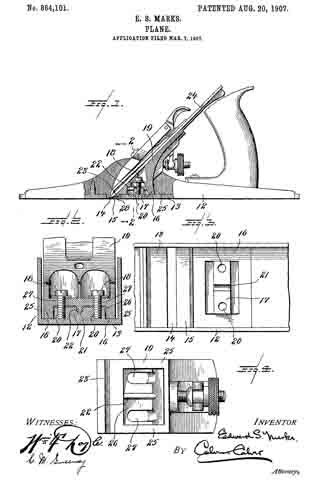
Referring to the drawings accompanying and forming part of this specification, Figure 1 is a side elevation, partly in section, of a plane made in accordance with my invention. Fig. 2 is a cross section of the plane stock and frog, taken substantially on the line 2–2, Fig. 1. Fig. 3 is a plan of a portion of the sole with the frog removed, showing the frog seat. Fig. 4 is a bottom plan view of the seating portion of the frog.

Like characters indicate like parts throughout the several views of the drawings.

12 indicates the stock or body of the plane, having a sole 13 provided with the usual throat or mouth 14, at the rear of which the sole is cut away at its upper side to provide a thinned down portion 15. Directly in the rear of said thinned down portion 15 is formed, preferably upon the sole of the plane itself, a single, continuous frog seat 16.

The frog seat 16 is adapted, alone, to support the frog, and to this end it is made of sufficient area to provide the necessary extended bearing surface to seat the frog firmly and to prevent any rocking movement thereof. The seat 16, as shown, lies wholly in a single plane substantially coincident with the upper surface of the sole, and, in the embodiment of my invention herein illustrated, is constructed in the form of a hollow rectangle, although it is obvious that many changes in the specific form of this seat might be made without departing from the spirit of my invention.

Located within and surrounded by the seat 16, and extending transversely of the sole of the plane, is a boss or rib 17. This rib is provided in order to furnish sufficient thickness of material to insure a secure engagement of the bolts 18, 18, which serve to clamp the frog 19 to its seat. To this end the boss or rib 17 is provided with threaded openings 20, for the reception of the attaching bolts 18. Preferably and as herein shown the rib 17 is provided with a transverse groove or notch 21 for the reception of a guiding or centering rib 22, on the frog 19. It will thus be seen that the boss or rib 17, provides means for engaging the attaching bolts 18, 18, and also means for guiding or preventing undue lateral movement of the frog 19, but in no other sense does the boss 17 support the frog, there being a slight clearance provided between the upper surface of the boss 17 and the opposite lower surface of the frog 19, and between the bottom of the groove 21 and the crest of the rib 22.

The frog 19 is provided with a depending lip 23, for supporting the bit 24 close to its cutting edge, and with a continuous seating portion 25, codperating with the seat 16. Surrounded by said seating portion 25 is a recess 26, for the reception of the boss 17 in the bottom of which recess is located the rib 22, and the slots 27, 27, for the passage of the attaching bolts 18, 18.

It will be noticed that a slight clearance, indicated by the numeral 28 in Fig. 1, is provided between the lower edge of the lip 23, and the thinned down portion 15 of the sole. These two parts are never allowed to come into engagement with one another, and all tendency to distort or warp this necessarily weak part of the sole is entirely prevented. The continuous frog seat 16 is oi sufficient extent to provide an absolutely firm bearing for the frog without any necessity for the frog to find an additional bearing on the thinned down portion 15 of the sole. Moreover my construction provides a wide seating area for the frog combined with a compactness of parts which is very desirable.

It will be further noticed that the frog is seated directly upon the sole, thus doing away with the heavy raised portions which have heretofore been considered necessary in order to provide the necessary bearings for the attaching screws of the frog, but which are difficult to cast satisfactorily, and which support the frog in an objectionably high position, or which have been omitted at the expense of the strength and durability of the plane. In my construction, however, the relatively small lug 17, which is not difficult to cast, provides sufficient thickness of metal to hold the attaching screws firmly, while the frog has a broad, flat, and desirably low support.

While I have shown and described one form in which my invention may be embodied, I wish it to be distinctly understood that I do not limit myself to the precise construction shown, it being obvious that many changes may be made therein without departing from the spirit of my invention.

Having thus described my invention I claim and desire to secure by Letters Patents —

1. In a plane, the combination with a sole having a frog seating surface lying in a single plane and a raised boss or rib provided with frog attaching means, of a frog having a plane seating surface adapted to cooperate with the seating surface on said sole, and cooperating means on said boss or rib and said frog for preventing relative lateral movement of said frog and sole.

2. In a plane, the combination with a sole having a single plane frog seating surface and a raised boss or rib provided with a groove, of a frog having a recess to receive said boss and a rib adapted to cooperate with said groove.

3. In a plane, the combination with a sole provided with a frog seating surface lying in a plane substantially coincident with the remainder of the upper surface of said sole and with a boss or rib rising above the plane of said frog seating surface, of a frog provided with a single seating surface adapted to coijperate with the seating surface on said sole and with a recess to receive said boss or rib, means cooporating with said boss or rib for attaching said frog to said frog seat, and coperating means on said boss or rib and said frog for preventing relative lateral movement of said frog and sole.

4. In a plane, the combination with a sole provided with a frog seating surface lying in a plane substantially coincident with the remainder of the upper surface of said sole and with a boss or rib rising above the plane of said frog seating surface, said boss or rib having a threaded aperture, of a frog provided with a single seating surface adapted to cooperate with the seating surface on said sole and with a recess to receive said boss or rib, a bolt cooperating with the aperture in said boss or rib for attaching said frog to said frog seat, and coiiperating means on said boss or rib and said frog for preventing relative lateral movement of said frog and sole.

5. In a plane, the combination with a frog having a depending lip, of a sole provided with a throat or mouth, a thinned down portion in the rear of said throat or mouth, a frog-seating surface lying in a plane substantially coincident with the remainder of the upper surface of said sole, and a boss or rib rising above the plane of said frog seating surface, means cooperating with said boss or rib for securely clamping said frog to said seat, said depending lip being out of contact with said thinned down portion, and coiiperating means on said boss or rib and said frog for preventing relative lateral movement of said frog and sole.

6. In a plane, the combination with a frog, of a sole having a throat or mouth. a frog seating surface in the rear of said mouth, and lying in a plane substantially coincident witli the remainder of the upper surface of said sole, and a boss or rib rising above the plane of said frog seating surface and provided with a frog-attaching means, and cooperating means on said boss or rib and said frog for preventing relative lateral movement of said frog and sole.

7. In a plane, the combination with a frog, of a sole having a plane frog seating surface and a raised boss or rib, and cooperating means on said boss or rib and said frog for preventing relative lateral movement of said frog and sole.

In testimony whereof I affix my signature, in presence of two witnesses.

EDWARD S. MARKS.

Witnesses:
JOHN W. BRAINARD,
RALPH R. KEELER.
No. 864,010 – Plane (Edward S. Marks) (1907)

[paiddownloads id=”643″]864010


UNITED STATES PATENT OFFICE.

_________________

EDWARD S. MARKS, OF AUBURN, NEW YORK, ASSIGNOR TO OHIO TOOL COMPANY, OF AUBURN, NEW YORK, A CORPORATION OF NEW YORK.

PLANE.

_________________

864,010. Specification of Letters Patent. Patented Aug. 20, 1907.
Application filed March 7, 1907. Serial No. 361,029.

_________________

To all whom it may concern:

Be it known that I, EDWARD S. MARKS, a citizen ofthe United States, residing at Auburn, in the county of Cayuga and State of New York, have invented or discovered certain new and useful Improvements in Planes, of which the following is a specification, reference being had therein to the accompanying drawings.

My invention relates to adjustable handles for planes.

The object of my invention is to provide a handle of the character specified which shall be simple in character, which may be easily and quickly adjusted to any desired position, and which will be securely and rigidly held in its adjusted position.

To these ends my invention, in its preferred form, comprises a handle rockingly mounted on a concave seat with which the base of the plane is provided, cooperating devices on the handle and base, which, when in engagement with one another, are adapted to hold the handle against tilting movement, and means for securely locking the handle in a position with said interlocking devices in engagement with one another.

While, as above stated, I prefer to form the handle and its seat on the base of the plane with interlocking devices I consider it to be within the scope of my invention to omit these devices and to hold the handle in its adjusted position by means of the aforesaid locking means alone, or to form these cooperating interlocking devices upon the handle and some part of the body of the plane other than the base thereof.

One construction in which my invention may be embodied is illustrated in the accompanying drawings, in which:–

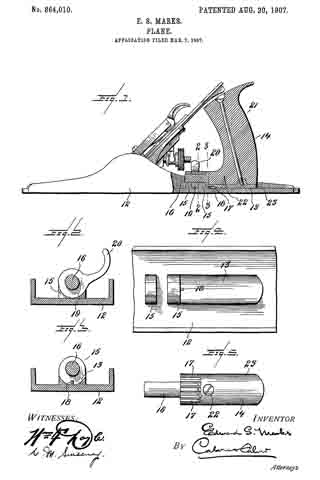
Figure 1 represents a longitudinal section through the handle portion of a plane constructed in accordance with my invention. Figs. 2 and 3 are cross-sectional views taken on the lines 2–2 and 3–3, respectively, Fig. 1. Fig. 4 is a plan view of the base of the plane shown in Fig. 1, with the handle member and clamping device removed. Fig. 5 is a bottom plan view of the handle member shown in Fig. 1.

Like characters indicate like parts throughout the several views of the drawings.

The base 12 of the plane is provided with a concave seat 13, firmly supporting the handle member 14 rockingly seated thereon, and with means for further pivotally supporting said handle member, said means as herein shown comprising a pair of upstanding, perforated lugs 15, 15, formed integral with the base 12. The handle member 14 is provided with a fixed, rigid, forwardly projecting pintle 16, adapted to enter the perforations in the lugs 15, 15, and is preferably formed with a convex under surface to cooperate with the concave seat 13.

As heretofore stated, I prefer to form the handle member and base with cooperating interlocking devices adapted to prevent rocking movement of the handle member when said devices are in engagement with one another, and to this end, in the construction shown, the handle member 14 is provided on its under surface with a plurality of’ grooves or recesses, 17, 17, while the base of the plane, at the junction of the seat 13 with the base of the rearmost lug 15, is provided with a lug 18, adapted to enter any one of the grooves 17, 17, according to the angular position of the handle member 14.

Means are provided for clamping the handle member 14, and for holding the same securely against any movement longitudinally of the plane. This means, in the construction shown, comprises an eccentric locking device 19, rotatably mounted on the pintle 16, between the lugs 15, 15. The locking device 19 is provided with a finger piece 20 by means of which it may be operated, and is adapted, when in its operative position, as shown in Fig. 2, by means of a wedging action between the base 12 and the pintle 16, to force the pintle 16 tightly against the upper sides of the perforations in the lugs, 15, 15, thereby securely holding the handle member against either longitudinal or rotary movement.

As herein shown the handle member 14 comprises a wooden handle 21, to which is permanently attached, as by a suitable screw 22, a metal shoe 23, the pintle 16, and grooves 17, 17 being formed upon said shoe 23. lt will be obvious, however, that the handle member 14, might be made in a single piece from suitable material.

In order to adjust the handle to any desired position, the finger piece 20 is raised from the position shown in Fig. 2, thereby releasing the locking device 19. The handle member 14 is then moved bodily backward until the lug 18 is clear of the groove 17, 17, after which the handle is turned into the desired position with one of the grooves 17, 17, opposite the lug 18. The handle is then moved forward into its original longitudinal position, thereby causing the lug 18 to enter the desired groove 17, and the locking device 19 again moved to locking position.

While I, in order that my invention may be more easily understood, have described the same as embodied in the particular construction shown, I wish it to be distinctly understood that I do not limit myself to this construction, it being obvious that many changes might be made therein without departing from the spirit and scope of my invention.

The concave seat 13 herein shown provides a much firmer support for the handle member than is provided in any construction of which I am aware.

Having thus described my invention I claim and desire to secure by Letters Patent:

1. In a plane, the combination with a concave handle seat, of a handle rockingly mounted thereon for angular movement transverse to the plane, and devices for retaining said handle in adjusted position.

2. In a plane, the combination with a base provided with a concave handle seat, of a handle rockingly mounted on said seat and pivotally connected to said base, and devices for retaining said handle in adjusted position.

3. In a plane, the combination with a handle mounted for angular adjustment and for longitudinal movement, of means for engaging said handle to hold the same against angular movement when in one longitudinal position, and means for locking said handle against longitudinal movement.

4. In a plane, the combination with a base provided with a curved handle seat, a locking lug, and one or more perforated lugs, of a handle member with a curved base to cooperate with said curved seat, a plurality of grooves adapted to cooperate with said locking lug, and with a forwardly projecting pintle entering said perforated lugs, and a clamping device engaging said pintle.

5. In a plane, the combination with a concave handle seat provided with a projecting lug, of a handle provided with a plurality of grooves adapted to receive said lug, and means for holding said handle with said lug in engagement with one of said grooves.

6. In a plane, a rockingly mounted handle, interlocking means on said handle and a fixed part oi the plane for holding said handle against rocking movement, said handle being bodily movable to release said interlocking means.

7. In a plane, the combination with a base provided with a concave handle seat, a locking lug, and one or more perforated lugs, of a handle member provided with a convex base, a plurality of grooves adapted to cooperate with said locking lug, and with a forwardly projecting pintle entering said perforated lugs, and a clamping device engaging said pintle.

8. In a plane, the combination with a plurality of bearing members, of a handle member having a projecting portion adapted to turn in said bearing members, and clamping means engaging said projecting portion beyond one of said bearing members.

In testimony whereof I affix my signature, in presence of two witnesses.

EDWARD S. MARKS.

Witnesses:
JOHN W. BRAINARD,
RALPH R. KEELER.
No. 864,009 – Adjustable Handle For Bench-Planes (Edward S. Marks) (1907)

[paiddownloads id=”642″]864009


UNITED STATES PATENT OFFICE.

_________________

EDWARD S. MARKS, OF AUBURN, NEW YORK, ASSIGNOR TO OHIO TOOL COMPANY, OF AUBURN, NEW YORK, A CORPORATION OF NEW YORK.

ADJUSTABLE HANDLE FOR BENCH-PLANES.

_________________

864,009. Specification of Letters Patent. Patented Aug. 20, 1907.
Application filed March 7, 1907. Serial No. 361,028.

_________________

To all whom it may concern:

Be it known that I, EDWARD S. MARKS, a citizen of the United States, residing at Auburn, in the county of Cayuga and State of New York, have invented or discovered certain new and useful Improvements in Adjustable Handles for Planes, of which the following is a specification, reference being had therein to the accompanying drawings.

My invention relates to improvements in adjustable handles for planes.

The object of my invention is to provide a reliable handle of the character specified which shall be simple in construction and which may be easily and quickly adjusted to any desired position.

To this end my invention comprises a preferably concave handle seat, a handle pivotally mounted on the body or stock of the plane and supported by said seat, and a device herein shown as a collar applied to the forwardly extending end of the handle and having a shoulder to bear against the sole of the plane, for locking the handle against tilting movement.

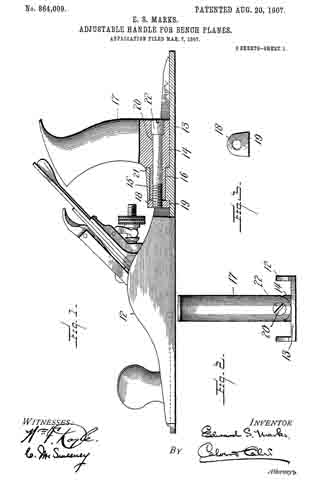
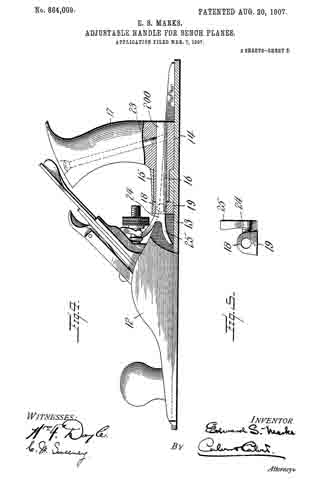
In the drawings accompanying and forming part of this specification, and illustrating a construction in which my invention may be embodied: Figure 1 is a vertical, longitudinal section of the handle portion of a plane constructed in accordance with my invention: Fig. 2 is a rear view of the same; Fig. 3 is an elevation of a collar hereinafter referred to; Fig. 4 is a view, similar to Fig. 1, of a modification. Fig. 5 is a view, similar to Fig. 3, of the collar used in the modification illustrated in Fig. 4.

Like reference characters indicate like parts throughout the several views of the drawings.

12 indicates the body or stock of the plane provided with the usual sole portion, 13. Upon the sole 13 is formed a concave handle seat 14, and an upstanding boss or lug 15 longitudinally bored to provide a bearing for a rounded, forwardly projecting portion 16 of the handle 17. The handle 17 is adapted to turn in its bearing in the boss 15, and to rock upon the seat 14 for the purposes of adjustment. Means are provided for locking the handle 17 in any desired position of adjustment, said means, as herein shown, comprising a collar 13, shown in detail in Figs. 3 and 5, having a shoulder or flattened portion 19 adapted to hear on the sole of the plane.

In the construction shown in Figs. 1 to 3, the collar 18 is formed as a nut adapted to engage the threaded end of a rod 20 passing through the handle 17, and the extension 16 thereof, and being provided at its rear end with a head 22, having means whereby said rod may be turned by means of a screw driver or other tool. The handle 17 is preferably provided with a shoulder 21, and when the rod 20 is turned to tighten the collar 18, the boss 15 will be clamped between the shoulder 21 and the collar 18, and the handle securely held against angular displacement, while the shoulder 19 on the collar 13 prevents rotation of the latter.

In the modification illustrated in Figs. at and 5 the collar 18 is provided with a smooth interior bore for the reception of an unthreaded rod 200, similar to the rod 20, but held against rotation in the handle 17 by a bolt 23. In this construction the collar 18 is tapped to receive a set screw 24, preferably provided with a finger piece 25. It will be obvious that when the set screw 24 is tightened upon the rod 200 the handle 17 will be securely held against turning or rocking movement, the shoulder 19, as heretofore stating, holding the collar 18 against rotation.

I do not limit myself to the precise constructions shown, it being obvious that many changes may be made in the details thereof without departing from the spirit or scope of my invention.

I claim:–

1. In a plane, the combination with a bearing, of a handle member having a projecting portion adapted to turn in said bearing, and clamping means engaging said projecting portion beyond said bearing.

2. In a plane, the combination with a bearing, of a handle member having a projecting portion rotatably mounted in said bearing, a collar detachably secured to said projecting portion beyond said bearing, and means for holding said collar against rotation.

3. In a plane, the combination with a sole and a bearing carried by said sole, of a handle member having a projecting portion rotatably mounted in said bearing, and a collar detachably secured to said projecting portion beyond said bearing, said collar having a shoulder engaging said sole.

4. In a plane, the combination with a sole provided with a bearing and a concave seat, of a handle member tiltingly mounted on said seat and having a projecting portion rotatably mounted in said bearing, and a collar detachably secured to said projecting portion beyond said bearing.

5. In a plane, the combination with a sole provided with a longitudinally bored boss, of a handle member seated upon said sole and having a projecting portion rotatably mounted in the bore of said boss, a rod extending longitudinally through said projecting portion, and a collar detachably secured to said rod beyond said boss.

6. In a plane, the combination with a bearing, of a handle member having a projecting portion rotatably mounted in said bearing, a collar mounted on said projecting portion beyond said bearing, and means for clamping said collar to said projecting portion.

7. In a plane, the combination with a bearing, of a handle member having a projecting portion rotatably mounted in said bearing, a rod extending longitudinally through said projecting portion, a collar mounted on said rod beyond said bearing, and a set screw in said collar engaging said rod.

8. In a plane, the combination with a bearing, of a handie member having a projecting portion rotatably mounted in said bearing, a rod extending longitudinally through said projecting portion, means for preventing rotation of said rod and said handle, a collar mounted on said rod beyond said bearing, and a set screw in said collar engaging said rod.

9. In a plane, the combination with a bearing, of a handle member, having a projecting portion rotatably mounted in said bearing, a rod extending longitudinally through said projecting portion, a collar mounted on said rod beyond said bearing, means for holding said collar against rotation, and a set screw in said collar engaging said rod.

In testimony whereof I aflix my signature, in presence of two witnesses.

EDWARD S. MARKS.

Witnesses:
JOHN W. BRAINARD,
RALPH R. KEELER.
No. 680,056 – Plane (Edward S. Marks) (1901)

[paiddownloads id=”556″]680056


UNITED STATES PATENT OFFICE.

_________________

EDWARD S. MARKS, OF AUBURN, NEW YORK,
ASSIGNOR TO OHIO TOOL COMPANY, OF NEW YORK.

PLANE.

_________________

SPECIFICATION forming part of Letters Patent No. 680,056, dated August 6, 1901.
Application filed December 10, 1900. Serial No. 39,447. (No model.)

_________________

To all whom it may concern:

Be it known that I, EDWARD S. MARKS, a citizen of the United States, and a resident of the city of Auburn, in the State of New York, have invented certain new and useful Improvements in Planes, of which the following is a specification.

This invention relates to the devices by which the chisel is adjusted in relation to the plane-stock; and it consists in certain new constructions and arrangements of the parts by which this adjustment is effected.

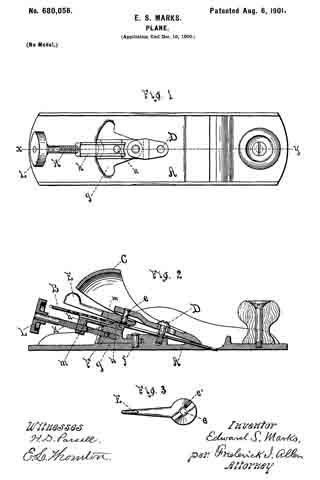
In the drawings, Figure 1 is a plan of a plane-stock provided with my improvements. Fig. 2 is a vertical section upon the line x y of Fig. 1, and Fig. 3 shows the lever separately.

Similar reference-letters indicate like parts in the several views.

In the drawings, A is the plane-stock. B is the chisel, which is secured by means of the cap C, which is held by the screw D and is locked by means of the lever E, pivoted at e and carrying a cam e’.

The foregoing parts are of usual construction.

Upon the plane-stock a carriage F is pivoted at f, which oscillates in the horizontal plane across the bed g. The carriage F is furnished with a slide h, seated thereon, and actuated by a screw K, which extends to the rear of the carriage F and is turned by its head L. A projection n upon the slide h, engages a corresponding depression or aperture m, in the chisel and holds the latter in position.

In operation the lengthwise adjustment of the chisel is performed by rotating the screw K, and by moving the carriage F upon its pivot f crosswise the lateral adjustment of the chisel is effected.

Wliat I claim as new, and desire to secure by Letters Patent, is —

In a plane and in combination; a plane-stock; a chisel mounted therein; means for clamping said chisel in said stock; a carriage pivotally mounted on said plane-stock so as to permit a lateral adjustment of said carriage and the parts supported thereby; a slide mounted on said pivoted carriage, and engaging said chisel ; and means carried by said carriage to adjust said slide and chisel longitudinally.

Signed at Auburn, New York, this 6th day of December, A. D. 1900.

EDWARD S. MARKS.

Witnesses:
H. D. PARSELL,
FREDERICK I. ALLEN.

No. 680,055 – Plane (Edward S. Marks) (1901)

[paiddownloads id=”555″]680055


UNITED STATES PATENT OFFICE.

_________________

EDWARD S. MARKS, OF AUBURN, NEW YORK,
ASSIGNOR TO OHIO TOOL COMPANY, OF NEW YORK.

PLANE.

_________________

SPECIFICATION forming part of Letters Patent No. 680,055, dated August 6, 1901.
Application filed December 4, 1900. Serial No. 38,705. (No model.)

_________________

To all whom it may concern:

Be it known that I, EDWARD S. MARKS, a citizen of the United States, and a resident of the city of Auburn, in the county of Cayuga and State of New York, have invented certain new and useful Improvements in Planes, of which the following is a specification.

This invention consists in certain new devices used to regulate the position of the chisel in relation to the plane-stock; and its object. is to furnish means for readily adjusting the chisel both longitudinally and laterally.

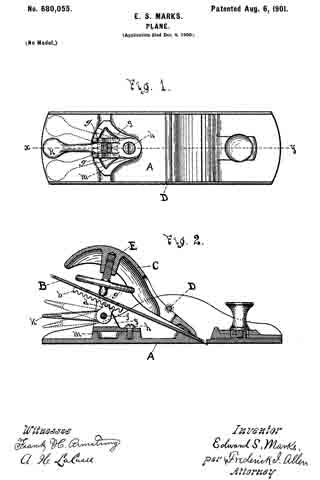
In the drawings, Figure 1 is a plan of a plane provided with my improvements and with the chisel and retaining-cap removed; and Fig. 2 is a sectional view upon the line x y of Fig. 1, showing the chisel and cap in position.

Similar reference-letters indicate like parts in both views.

In the drawings, A is the plane-stock, B is the chisel, and C the cap-iron, which is secured under the cross-bar D by means of the screw E.

The chisel B is provided with a rack b, and a pinion-section d, pivoted at f and operated by a lever K, engages it. The dotted lines of Fig. 2 indicate different positions which this lever may occupy in the vertical plane. By this means the chisel is moved in the direction of its length as required.

The carriage g, which supports the pivot f, is pivotally secured at h, so that it may be moved laterally, and the dotted lines of Fig. 1 show dilierent positions which it may occupy in the horizontal plane, the upright ears g’, rising from the carriage g, straddling the rack b on the under side of the chisel B and lengaging the parts for lateral adjustment, as shown in Fig. 2, the segment m upon the plane-stock furnishing a support for it in its different positions.

By the above-described means the chisel B is readily adjusted either vertically or laterally, as desired.

What I claim as new, and desire to secure by Letters Patent, is —

1. In a plane and in combination, a plane-stock, a chisel, means for clamping said chisel in said plane-stock, a carriage having a vertical pivotal connection with said plane-stock, a lever carried by and having a horizontal pivotal connection with said carriage to shift said carriage laterally on its pivot, means on said carriage to engage and shift said chisel laterally, and means on said pivoted carriage-lever to engage said chisel and shift it longitudinally.

2. In a plane and in combination, a plane-stock, a chisel, means for clamping said chisel in said plane-stock, a carriage having a vertical pivotal connection vvith said plane-stock, a segment formed on said stock to support said carriage, a lever carried by and having a horizontal pivotal connection with said carriage to shift said carriage laterally on its pivot, upright ears on said carriage to engage and shift said chisel laterally, and means on said pivoted carriage-lever to engage said chisel and shift it longitudinally.

Signed at Auburn, New York, this 1st day of December, A. D. 1900.

EDWARD S. MARKS.

Witnesses:
HENRY D. PARSELL,
FREDERICK I. ALLEN.